Found 1 answers matching your query:
NeXus FAQ
Please see below for the most common questions we are asked about NeXus:
Why does NeXus only work with a single GPU?
Why is my NeXus project freezing my system or not emitting particles?
Why is my NeXus project not working at all?
Can NeXus projects be rendered over a network?
Will my GPU work with NeXus?
As long as your GPU has at least 4GB of VRAM and supports Vulkan, we would expect NeXus to work with most modern versions of Nvidia, AMD, Apple M Series graphics cards.
Why does NeXus only work with a single GPU?
If rendering, this will send all the scene information to each individual GPU and this can then render a small tile of the final image independently of all other tiles.
Unlike rendering, which is easily distributed across multiple GPUs, running a simulation has to send all of the data to a single GPU as the calculations are dependent on all of the particles.
Why is my NeXus project freezing my system or not emitting particles?
If Cinema 4D freezes, your simulation stops working or your particles are sticking to the emitter on emission when using NeXus, it is likely that your GPU has timed out and rebooted due to a delayed response.
When this happens, the GPU terminates itself and you will need to restart Cinema 4D for your scene to work as expected.
To stop this happening again, you can:
• Ensure that your GPU can handle the scene contents, which may require using less particles or cleaner geometry.
• Ensure that any other Cinema 4D projects have been closed and if you do need to keep them open, that the viewport is set to the starting frame to stop interference from other active simulations.
• Close any other applications that may be utilizing your GPU.
On Windows systems, GPU timeout is managed via the GPU Timeout Detection & Recovery (TDR) and this can be increased if needed, but this is not possible on MacOS
How to add/change the TDR Delay on Windows systems
Run regedit, the Windows Registry Editor
Navigate to: HKEY_LOCAL_MACHINE\System\CurrentControlSet\Control\GraphicsDrivers
If the TdrDelay key exists, double-click on it and change it’s value to 5 or 8.
If the TdrDelay key does not exist, add the key by:
Edit -> New -> DWORD (32bit Value)
Name the key TdrDelay
Double-click the key, make it a Decimal (instead of Hexadecimal) value and set it to 60.
Reboot your system.
Please note that updating Windows can reset the TDR Delay value, so you may need to repeat this process after each update.
Why is my NeXus project not working at all?
Your scene is likely not working at all as your available VRAM has run out.
You can try increasing the available VRAM via the INSYDIUM Preferences, below. If this does not work, you will need to make your scene less intensive.
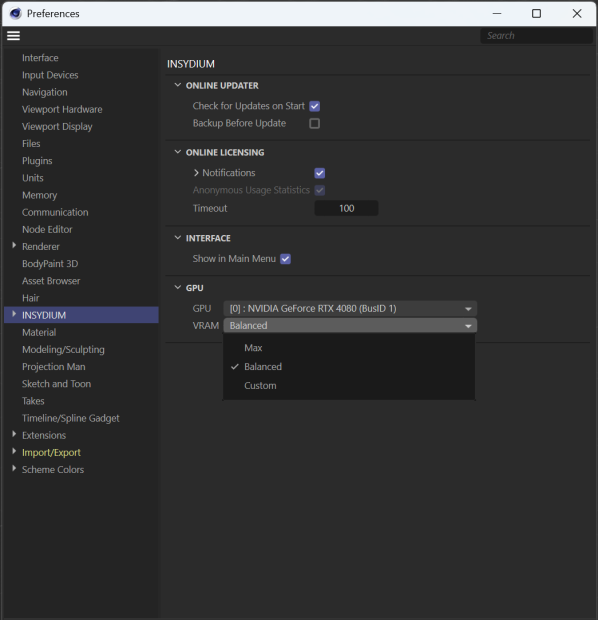
If the scene does not work with increased VRAM, please check your GPU drivers are up to date and if using Nvidia, try both the Studio and Gaming packages.
If still not working, it is likely that your system does not have enough VRAM to play the scene and you will need to streamline it to make it less intensive.
Can NeXus projects be rendered over a network?
Due to the way that data is handled via the GPU, network rendering, including Team Render cannot be used when rendering projects that include NeXus Objects.
Can you cache NeXus Objects?
Yes, the xpCache will work with NeXus Objects.
Popular topics
Contact us
Already a customer?
For queries about your Customer Account, license(s) or product, contact our Support team.
Contact SupportThinking of buying?
Contact our Sales team for information about product pricing, academic and other discounts or existing orders.
Contact Sales